The Czech Republic, in the heart of Central Europe, is far more than its capital. Prague alone could fill a week, but beyond it lie a UNESCO-listed medieval town, spa cities, wine country, castles, and a sandstone wilderness, all reachable by train in a few hours. It is also one of Europe’s better-value destinations, which makes it an easy choice for a first trip to Central Europe or a return visit with more time.
Prague: The Heart of the Czech Republic
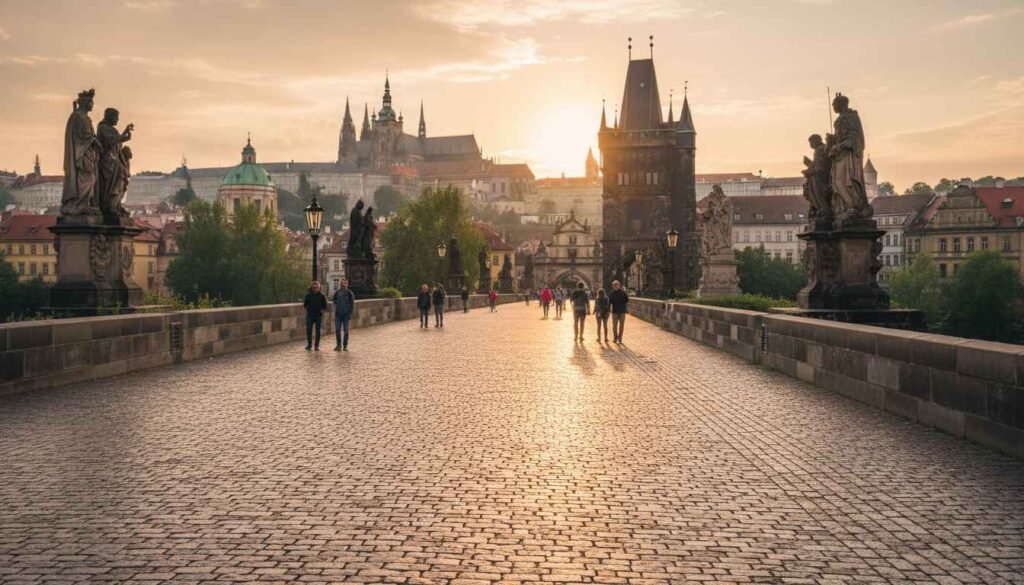
Start in Prague, a city that survived the 20th century with its historic center largely intact. Prague Castle, one of the largest castle complexes in the world, overlooks the Vltava River, and Charles Bridge, begun in 1357, connects it to the Old Town. In Old Town Square, the medieval Astronomical Clock still draws a crowd every hour, and the surrounding lanes hold Gothic churches, Art Nouveau facades, and cafes. Cross to the Lesser Town (Malá Strana) for quieter streets, baroque palaces, and views back across the river. Two full days is a minimum for Prague; three lets you add a day trip without rushing.
Český Krumlov and South Bohemia
South of Prague, Český Krumlov is the Czech Republic’s best-preserved medieval town, a UNESCO World Heritage site since 1992, where a castle towers over a bend in the Vltava and the old town’s lanes are made for wandering. Rafting or canoeing a gentle stretch of the Vltava is a popular summer activity here. Nearby, the small town of Telč, with its Renaissance square, makes a quiet detour on the way south.
Spa Towns and Castles
The Czech spa tradition is centuries old. Karlovy Vary, in the west, is the grandest of the spa towns, with colonnades, hot springs, and elegant hotels that once hosted European royalty. For castles, head to Karlštejn, the 14th-century Gothic fortress built to guard the Bohemian crown jewels, or to Hluboká Castle in the south, a white Neo-Gothic palace that looks borrowed from a fairytale. Both are easy half-day trips.
Brno and the Moravian Wine Country
Brno, the Czech Republic’s second city, is livelier and less touristy than Prague, with the Špilberk Castle overlooking the center and a growing food and cafe scene. South of Brno, the Moravian wine region around Mikulov and Valtice offers vineyard villages, wine cellars, and cycling paths between small towns. If you enjoy wine, this is the Czech Republic’s answer to a tasting holiday, and it pairs well with a few days in Brno.
Nature: Bohemian Switzerland and Beyond
For scenery, head north to Bohemian Switzerland National Park, where sandstone cliffs, deep gorges, and pine forests meet the German border. Its best-known sight is Pravčická brána, the largest natural sandstone arch in Europe, reached by a forest walk. Further east, the Adršpach-Teplice rock formations offer a maze of towering stone pillars. Both areas are best in late spring or early autumn, when the trails are quieter.
Planning Your Czech Republic Trip
Prague works as a base, with trains to most destinations taking two to four hours, so a car is not necessary unless you are exploring wine villages or remote parks. May to September brings the best weather, while December adds Christmas markets in Prague and Brno. Prices are lower than in Western Europe, though Prague’s center is the priciest part of the country. If you are building a wider European journey, our guide on how to plan a multi-city trip will help you sequence the stops, and our guide to the top places to visit in Split, Croatia covers another popular European destination if you are heading further south.
FAQ
- How many days do you need in the Czech Republic?
Five to seven days is ideal: three days in Prague, one or two in Český Krumlov or Karlovy Vary, and a day in Brno or the countryside. Prague alone deserves at least two full days.
- Is the Czech Republic expensive to visit?
No, by Western European standards it is good value. Meals, beer, and transport are affordable, though hotels in central Prague cost more than elsewhere in the country.
- What is the best time to visit the Czech Republic?
May to September offers warm weather and long days. December is also popular for Christmas markets, while January and February are cold but quiet and cheap.
- Do you need a car in the Czech Republic?
Not for the main sights. Trains and buses connect Prague, Brno, Karlovy Vary, and Český Krumlov well. A car helps only for wine villages and remote national park areas.
The Czech Republic rewards travelers who go beyond Prague: a medieval town, a spa, a vineyard, and a sandstone gorge in one trip is a combination few European countries can match at these prices.