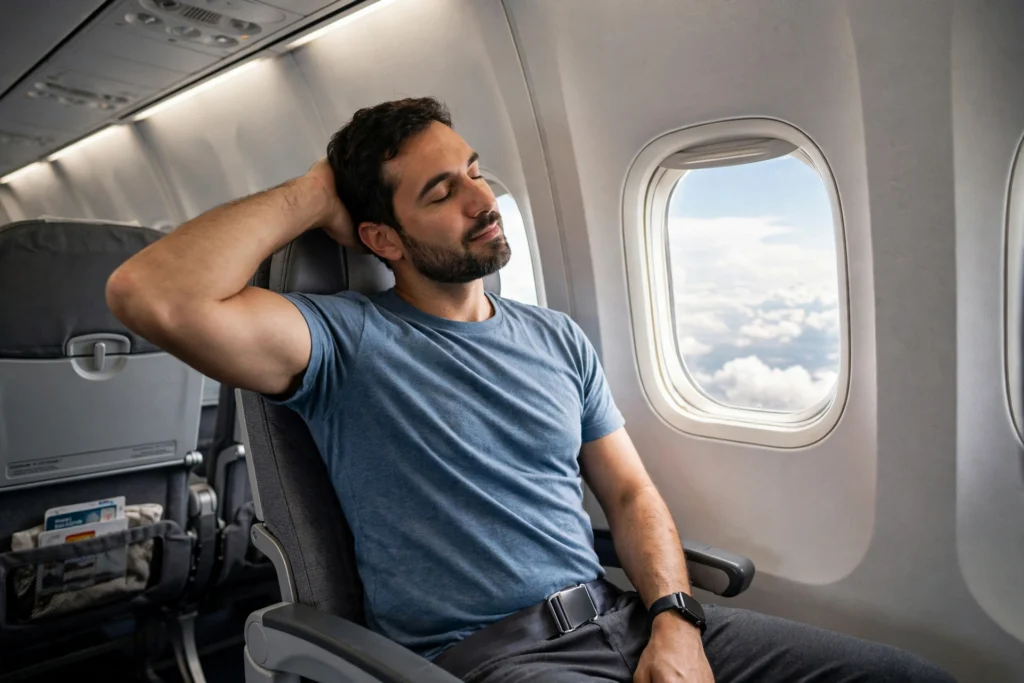
A long flight can leave even a seasoned traveler feeling stiff, achy and restless. Hours of sitting in a cramped seat slows your circulation, tightens your neck, shoulders and lower back, and can leave your legs feeling heavy. A few simple stretches, done right in your seat, can make a real difference to how you arrive.
Why Stretching on a Long Flight Matters
When you sit still for hours, blood pools in your lower legs and your muscles stiffen — which is why your ankles can feel puffy and your back can ache after a long-haul flight. Gentle movement helps your circulation by working the muscles that push blood back up toward your heart.
Sitting still for a very long time is also linked to a higher risk of blood clots in the legs, sometimes called deep vein thrombosis (DVT). The risk for most healthy travelers is low, and movement is one of the simplest ways to reduce it. Stretching is not a medical treatment, but it is a useful habit on any flight over a few hours.
Before You Start: A Few Ground Rules
Keep every stretch gentle and slow — a mild pull, never sharp pain. Breathe normally throughout. Stay in your seat space: keep elbows in, avoid kicking the seat in front, and save bigger movements for a trip to the aisle. If you have a medical condition or a recent injury, check with your doctor before flying.
10 Simple Stretches You Can Do on a Long Flight
1. Neck Rolls
Sit tall and slowly roll your head in a wide circle, first one way and then the other. Take about ten seconds per circle and do three in each direction. This eases stiffness from sleeping with your head tilted or staring at a screen.
2. Shoulder Shrugs and Rolls
Lift both shoulders up toward your ears, hold for three seconds, then drop them down and relax. Repeat five times. Then roll your shoulders backward in slow circles, five times, followed by five forward. This releases tension between your shoulder blades.
3. Seated Spinal Twist
Sit up straight, place your right hand on the outside of your left knee, and gently twist your upper body to the left, looking over your left shoulder. Hold for fifteen to twenty seconds, breathing slowly, then switch sides. Keep the movement slow and avoid forcing the twist.
4. Ankle Circles
Lift one foot slightly off the floor and slowly circle your ankle, ten times clockwise and ten times the other way, then switch feet. This keeps blood moving in your lower legs.
5. Seated Calf Raises
With both feet flat on the floor, lift your heels so you are up on the balls of your feet, hold for two seconds, then lower. Do this ten to fifteen times. Repeat every hour — it works the calf muscles that pump blood up from your legs.
6. Knee-to-Chest Stretch
Lift one knee toward your chest and hold it there with both hands for fifteen to twenty seconds, keeping your back straight against the seat. Lower it slowly and switch legs. This stretches your lower back and hips, which take the most strain from sitting.
7. Wrist and Forearm Stretch
Hold one arm out in front of you, palm down, and use your other hand to gently pull your fingers back toward you until you feel a stretch along the underside of your forearm. Hold for fifteen seconds, then switch hands. This helps after hours of typing, reading or holding a book.
8. Seated Forward Fold
Sit tall, then hinge forward from your hips and let your hands rest on your shins, keeping a slight bend in your spine rather than forcing it. Hold for fifteen to twenty seconds and rise slowly. This stretches your lower back and hamstrings without needing to stand up.
9. Chest Opener
Clasp your hands behind your back, or hold the armrests and squeeze your shoulder blades together, opening your chest. Hold for ten seconds and release, repeating three times. It reverses hours of hunching over a tray table or phone.
10. Standing Aisle Stretch
When you get up, take thirty seconds to stretch standing up: reach both arms overhead, stretch tall, then gently bend to each side. If there is space near the galley, add a slow standing calf stretch — one foot back, heel pressed to the floor. Keep it brief and stay out of the crew’s way.
How Often Should You Stretch on a Flight?
Do a short routine every one to two hours, plus ankle circles and calf raises every thirty minutes if your legs feel restless. You do not need all ten stretches each time — pick three or four for wherever you feel stiffest and rotate through the rest. A couple of minutes per session is enough; consistency matters more than intensity.
What NOT to Do
Do not bounce or jerk into a stretch — fast, forceful movements can strain a cold muscle, especially after hours of sitting. Do not push through sharp pain, numbness or tingling; those are signals to stop, not to stretch harder. Avoid standing stretches in the aisle when the seatbelt sign is on or when the crew is serving meals, and do not block the aisle or the exits. Finally, stretching works best alongside regular short walks, not instead of them.
Walk the Aisle, Too
Stretching and walking work as a pair. Get up and walk the cabin every couple of hours — a slow walk to the restroom and back, with a standing stretch at the end, does more for your circulation than any seated exercise alone. If you arrive stiff and groggy, a day-by-day jet lag recovery plan can help you reset.
When to Check With a Doctor
These stretches are general wellness suggestions, not medical advice. If you have a history of blood clots, circulation problems, recent surgery, a serious back or neck condition, or you are pregnant, talk to your doctor before your trip. The same goes if you notice unusual swelling, pain or redness in one leg during or after a flight — get that checked promptly rather than stretching through it.
If your trip takes you to high places as well as long distances, our guide on how to avoid altitude sickness when traveling to the mountains covers the other side of staying well on the move.
Frequently Asked Questions
Is it safe to stretch on a plane?
For most healthy travelers, gentle seated stretches are safe on long flights. Keep movements slow and small, stop if anything hurts, and stay seated when the seatbelt sign is on.
How often should I stretch on a long flight?
Do a short routine every one to two hours, and repeat ankle circles and calf raises every thirty minutes if your legs feel stiff. A few minutes at a time is enough.
Can stretching prevent blood clots on a flight?
Stretching and walking help keep your blood circulating, which lowers one risk factor for clots forming in the legs. They reduce the risk but cannot eliminate it, and they are not a substitute for medical advice if you have a higher risk profile.
What is the best stretch for lower back pain on a flight?
The seated spinal twist and the knee-to-chest stretch target the muscles and joints that tighten while sitting. Combine them with a short walk up the aisle whenever you can.
Final Thoughts
A long flight does not have to leave you feeling wrecked on arrival. A handful of simple stretches, done gently every hour or two, plus a few short walks up the aisle, can keep your circulation moving and your muscles loose.