For companies dealing with industrial water treatment, groundwater contamination, wastewater management, process filtration, or emissions control, understanding what Envirogen Technologies offers can help clarify where specialized environmental technology fits into a broader sustainability strategy.
What Is Envirogen Technologies?
Envirogen Technologies is an environmental technology and process-solutions provider with more than 30 years of experience in water and air treatment, process development, engineering, equipment, and operations and maintenance services. The company serves industrial and non-industrial customers and has experience with applications involving groundwater, process water, wastewater, VOCs, odors, and resource recovery.
Its approach combines technology selection with engineering and lifecycle support rather than focusing only on supplying individual treatment equipment. This can be particularly useful for businesses where water quality, regulatory requirements, operating costs, and production reliability are closely connected.
How Envirogen Supports Sustainable Business Operations
Sustainability in industrial operations is not limited to reducing emissions or switching to renewable energy. Efficient management of water, wastewater, process materials, chemicals, and energy can also have a meaningful impact on an organization’s environmental footprint.
Envirogen’s solutions are designed around several operational objectives:
- Improving water and process quality
- Reducing water consumption and waste
- Supporting water reuse and recycling
- Reducing chemical and energy consumption where appropriate
- Managing difficult contaminants
- Improving system efficiency and reliability
- Supporting environmental and regulatory objectives
- Controlling long-term operating and lifecycle costs
Industrial Water Treatment Solutions
Industrial businesses often have very different water requirements depending on their processes. Incoming water, process water, boiler feedwater, cooling water, wastewater, and recycled water may each require different treatment strategies.
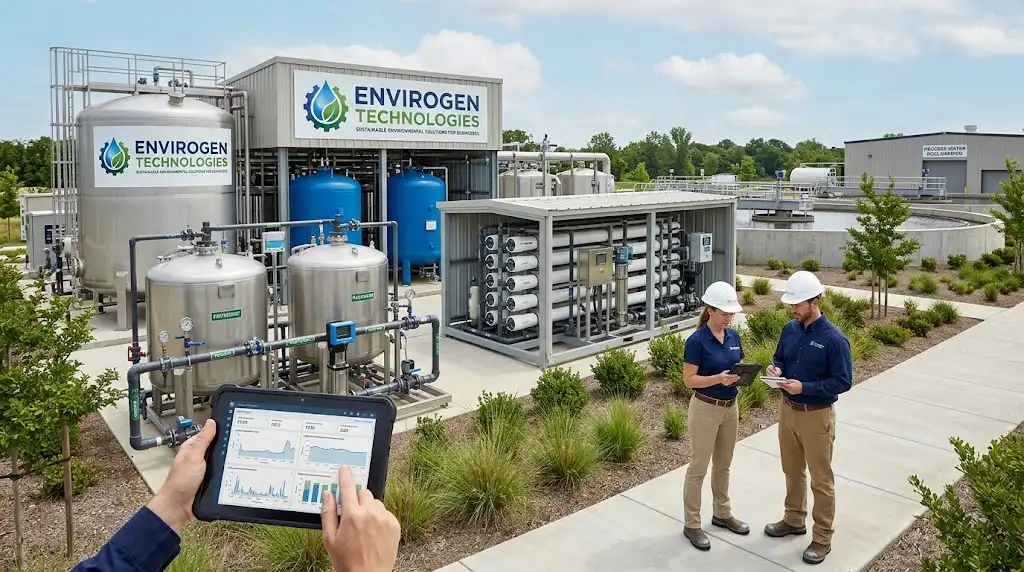
Envirogen provides technologies including reverse osmosis, ion exchange, filtration, biological treatment, membrane systems, and other specialized treatment approaches. The appropriate system depends on the characteristics of the water, contaminants involved, required quality, flow rate, and operational objectives.
Reverse Osmosis and Membrane Systems
Reverse osmosis uses a semi-permeable membrane to separate dissolved contaminants from water. Envirogen offers modular and customized reverse-osmosis systems for industrial applications, including solutions designed for high-purity water production and specialized process requirements.
Membrane optimization can also help organizations extend equipment life and maintain consistent treatment performance through monitoring, membrane testing, cleaning strategies, and appropriate system management.
Ion Exchange Technology
Ion exchange is used in applications requiring softened, demineralized, or otherwise treated water. Envirogen provides regenerable and single-pass ion exchange systems designed for different industrial water-treatment requirements.
These systems can also be configured for the removal of specific contaminants, making ion exchange useful when conventional treatment methods do not adequately address a particular water-quality problem.
Biological Water Treatment
Biological treatment uses microorganisms to help remove certain contaminants from water and wastewater streams. Envirogen’s biological treatment portfolio includes Fluidized Bed Reactors, Membrane Bioreactors, and Suspended Carrier Reactors.
These technologies can be configured for different applications and treatment conditions. The company states that its biological systems can address contaminants such as organics and certain oxyanions, depending on the selected process and application.
Wastewater Treatment and Water Reuse
Water reuse can be an important part of a business sustainability strategy, particularly for facilities with high water demand. Instead of treating water as a single-use resource, businesses can evaluate opportunities to recover and reuse water within appropriate process streams.
Envirogen’s total-water approach includes process water, utility feedwater, water pretreatment, filtration, recycling, water reuse, and wastewater recovery. The exact configuration depends on site conditions and the quality requirements of the intended reuse application.
Solutions for Manufacturing and Industrial Businesses
Manufacturing facilities can encounter complex water and environmental challenges because treatment requirements are often connected directly to production processes.
Envirogen works across sectors including chemical processing, pharmaceuticals, power, automotive and transportation, textiles, plastics and rubber, personal care, food and beverage, metal fabrication, and other industrial applications.
For these businesses, treatment systems may address incoming water, process water, boiler feedwater, cooling water, wastewater, stormwater, or specialized contaminants.
Air Treatment, VOCs, and Odor Control
Environmental management can extend beyond water. Certain industrial processes generate volatile organic compounds (VOCs), hazardous air pollutants, or unpleasant odors that require specialized treatment.
Envirogen offers biological air-treatment technologies including biofilters, biotrickling filters, and integrated systems. These technologies are designed for applications where biological treatment can provide an effective alternative to conventional thermal, chemical, or adsorptive approaches.
For businesses, the potential benefits include emissions management, reduced chemical consumption in suitable applications, and lower long-term operating requirements.
Why Lifecycle Performance Matters
Choosing an environmental treatment system involves more than comparing the initial equipment price. Installation, energy consumption, chemicals, maintenance, replacement components, downtime, monitoring, and ongoing service can significantly influence the total cost of a system.
Envirogen emphasizes what it describes as lifecycle performance. Its approach combines system design, engineering, installation, commissioning, operations, maintenance, and long-term support.
This approach allows businesses to consider environmental technology as a long-term operational asset rather than simply a one-time equipment purchase.
Industries That Can Benefit From Environmental Treatment Technology
Environmental treatment requirements vary considerably between industries. Envirogen has developed solutions for a broad range of sectors, including:
- Manufacturing
- Chemical processing
- Mining and minerals
- Food and beverage
- Pharmaceuticals
- Power and energy
- Petrochemical refining
- Automotive and transportation
- Municipal water applications
- Healthcare
- Military facilities
Because treatment requirements differ between facilities, businesses generally need site-specific assessment rather than assuming that one technology will work for every application.
How Businesses Can Evaluate an Environmental Technology Provider
Before selecting a treatment technology provider, businesses should evaluate several practical factors.
1. Technical Expertise
Look for experience with the specific contaminants, water chemistry, process conditions, and regulatory requirements relevant to the facility.
2. System Design Capability
A treatment system should be designed around the actual application. Flow rates, influent characteristics, required water quality, available space, energy requirements, and future capacity can all influence the final design.
3. Lifecycle Costs
Initial capital expenditure is only one part of the financial picture. Businesses should also consider maintenance, consumables, energy, chemicals, replacement components, staffing, and expected equipment life.
4. Operations and Maintenance
Ongoing service can be especially important for complex industrial treatment systems. Maintenance programs, monitoring, emergency support, and system optimization can help maintain consistent performance.
5. Sustainability Objectives
Organizations should identify measurable sustainability goals before selecting technology. Depending on the facility, those goals may involve reducing water consumption, increasing reuse, reducing waste, lowering chemical consumption, or improving energy efficiency.
Envirogen Technologies and the Future of Sustainable Industry
Businesses are increasingly expected to improve environmental performance while maintaining productivity and controlling costs. Water availability, wastewater requirements, resource efficiency, and environmental compliance can therefore become strategic operational concerns rather than isolated environmental issues.
Technology providers such as Envirogen Technologies address this intersection by combining treatment technologies with engineering, system design, project management, and ongoing operational support.
The most effective sustainability strategy will ultimately depend on the individual facility. Businesses should assess their water chemistry, process requirements, regulatory obligations, operating costs, and opportunities for reuse before selecting a treatment solution.
Final Thoughts
Envirogen Technologies represents a technology-focused approach to environmental and process challenges, with solutions spanning water treatment, wastewater treatment, process filtration, biological treatment, contaminant removal, and air and odor management.
Its emphasis on engineering, lifecycle performance, water efficiency, and long-term system support makes environmental treatment part of a broader operational strategy. For businesses seeking to improve resource efficiency while managing complex water or environmental requirements, understanding the available technologies and evaluating them against measurable site-specific objectives is an important first step.