
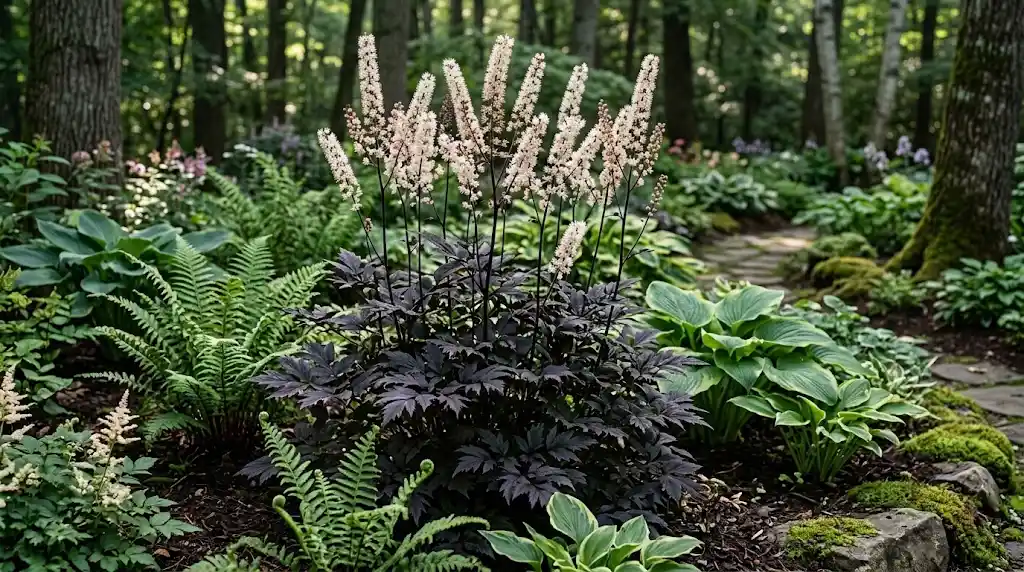
What Is Hillside Black Beauty Bugbane?
Hillside Black Beauty is a cultivated form of bugbane known for its dark purple to almost black foliage. The plant develops a relatively low mound of foliage before sending tall flowering stems upward later in the growing season.
The flowers are generally pale cream, white, or lightly pink-tinged and appear in narrow, wand-like clusters. Their fragrance adds another dimension to the plant, especially when several plants are grown together.
Garden references describe Hillside Black Beauty as a shade-loving or partial-shade perennial that prefers consistently moist soil. Mature plants can reach several feet in height when flowering, giving them valuable vertical presence in a garden border.
Why Its Dark Foliage Stands Out
The defining feature of Hillside Black Beauty Bugbane is its foliage. The purple-black leaves create a deep visual backdrop that can make nearby green foliage and lighter flowers appear more vivid.
This makes the plant useful for gardeners who want more than a traditional green perennial. Instead of depending entirely on flowers, you get a strong foliage display followed by tall, fragrant flower spikes later in the season.
The effect works particularly well in woodland-style designs. Ferns, hostas, and other shade-tolerant plants can provide contrasting textures around the darker foliage. You can also use the plant as a background specimen behind shorter perennials.
Light Requirements for Hillside Black Beauty
Hillside Black Beauty performs well in partial shade and can also tolerate deeper shade, depending on growing conditions. However, light levels can influence the intensity of its foliage color.
For gardeners interested in maintaining its characteristic dark appearance, a location with appropriate filtered or partial sunlight can be especially useful. Too much harsh afternoon exposure can stress the foliage, particularly when soil moisture is inadequate.
The Chicago Botanic Garden describes this cultivar as shade-loving and recommends consistently moist soil, while other horticultural references also emphasize partial shade and protection from excessive heat.
Soil and Watering Needs
Moisture is one of the most important factors when growing Hillside Black Beauty Bugbane. The plant prefers fertile soil containing organic matter and should not be allowed to remain dry for extended periods.
At the same time, consistently moist does not mean permanently waterlogged. Good drainage helps prevent problems around the roots while organic matter can improve the soil’s ability to retain moisture.
A layer of mulch around the plant can help moderate soil temperature and reduce moisture loss. Keep mulch slightly away from the crown of the plant rather than piling it directly against the stems.
When Does Hillside Black Beauty Bloom?
One of the reasons gardeners value bugbane is its late-season flowering period. After developing its dark foliage, Hillside Black Beauty produces tall stems carrying narrow clusters of pale, fragrant flowers.
Depending on the growing region and conditions, flowering generally occurs from late summer into early fall. The tall flower stems create an excellent vertical accent at a time when some earlier perennials are beginning to fade.
Its late-season presence makes it useful for extending visual interest in a perennial garden rather than concentrating all of the color in spring and early summer.
How Large Does Hillside Black Beauty Get?
Size varies with climate, soil, maturity, and growing conditions. The plant can form a substantial foliage clump, while flowering stems can rise several feet above the foliage.
The Morton Arboretum lists Hillside Black Beauty at approximately 4 to 6 feet tall and 2 to 4 feet wide, while other horticultural references give somewhat different measurements. This variation is normal for a perennial whose flowering height can be considerably greater than its foliage mound.
Best Companion Plants
Hillside Black Beauty works especially well with plants that appreciate similar moisture and shade conditions. Ferns can provide finely textured green foliage, while hostas offer broad leaves that contrast strongly with bugbane’s darker, more divided foliage.
Astilbes are another useful companion because their flower forms can complement the tall flowering wands of bugbane. Combining different heights and leaf shapes can create a layered garden rather than a planting that looks visually flat.
For additional inspiration, readers interested in outdoor environments and destinations can also explore relaxing places to visit around the world and places near Lassen National Park.
Is Hillside Black Beauty Low Maintenance?
Once established in a suitable location, Hillside Black Beauty can be relatively manageable. Its main requirements are appropriate light, consistent moisture, fertile soil, and protection from conditions that can damage tall flower stems.
It is also known for being deer resistant, which can make it useful in gardens where browsing animals are a concern. Some references also describe it as relatively easy to maintain once established, although the plant can take time to reach its mature form.
Gardeners should also watch for common foliage problems such as leaf spot and rust rather than assuming the plant is completely pest- or disease-free.
Planting and Establishment Tips
Choose a site with suitable shade and moisture before planting. Improve poor soil with organic matter if necessary, and water the plant consistently while it establishes its root system.
Patience is important. Hillside Black Beauty is not necessarily a plant that reaches its full ornamental impact immediately. Some horticultural sources note that it can take several years to form a mature clump.
Once established, avoid unnecessarily disturbing the plant. If propagation or division is desired, spring is commonly recommended for dividing established plants.
Does Bugbane Really Repel Bugs?
The name “bugbane” is connected to the plant’s strongly scented flowers and its historical association with insects. However, it is important not to treat Hillside Black Beauty as a substitute for proven mosquito-control products or pest-management methods.
The reliable horticultural descriptions emphasize its ornamental foliage, fragrant flowers, shade-garden value, and wildlife interest rather than presenting it as a dependable mosquito-repellent plant. That distinction matters when choosing a plant based on realistic garden expectations.
Using Hillside Black Beauty in a Modern Garden
This perennial fits particularly well into naturalistic, woodland, cottage, and contemporary shade gardens. Its dark foliage can introduce depth where a planting contains too many similar shades of green.
It can also work as a specimen plant, planted in a location where its unusual foliage can be appreciated throughout the season. Group planting can create an even stronger visual effect, particularly once the tall flower spikes emerge.
For readers interested in broader lifestyle and design ideas, Post Wave Rise also covers subjects such as timeless trends, Steampunk fashion, and Kawaii fashion.
Final Thoughts
Hillside Black Beauty Bugbane is a distinctive perennial for gardeners who want dramatic foliage, late-season flowers, and strong vertical structure. Its purple-black leaves provide visual depth, while its tall, pale flower spikes add height and fragrance later in the season.
The key to success is choosing the right environment: partial or suitable shade, fertile soil, and consistent moisture. With patience during establishment and thoughtful companion planting, Hillside Black Beauty can become a memorable feature of a perennial or woodland-style garden.
Rather than relying on exaggerated claims about pest control, its strongest appeal is its genuine horticultural character: unusual dark foliage, fragrant late-season flowers, shade-garden versatility, and a striking architectural presence.