What Is Cryptocurrency?
Cryptocurrency is a form of digital money that exists only online and is secured by cryptography — the same kind of mathematics that protects passwords and bank logins. Unlike the money in your bank account, most cryptocurrencies are not issued or controlled by a government or a central bank. Instead, transactions are recorded on a public ledger called a blockchain, which is maintained by a network of computers around the world. When you send cryptocurrency to someone, that transaction is checked by the network and added to the blockchain, where it becomes very difficult to change afterwards.
The best-known cryptocurrency is Bitcoin, launched in 2009 as the first of its kind. Ethereum followed in 2015 and added a new idea: programmable contracts, called smart contracts, that run on the blockchain. Today there are thousands of other cryptocurrencies, often called altcoins, each with its own purpose, community and level of risk. Some are designed as a store of value, some power applications, and some are little more than experiments. Understanding that variety is the first step, because not all cryptocurrencies are alike.
How Cryptocurrency Investing Works
Investing in cryptocurrency usually means buying a coin or token in the hope that it becomes more valuable over time — but it can also mean losing value, sometimes sharply. You buy through a cryptocurrency exchange, which is a platform where buyers and sellers trade. To use one, you typically create an account, verify your identity, add money from your bank account or card, and then place an order for the cryptocurrency you want.
Once you own cryptocurrency, you need somewhere to keep it. That is the job of a wallet. A wallet does not hold coins the way a physical wallet holds notes; it holds the private keys that prove you own the coins recorded on the blockchain. If someone else gets your private keys, they can take your funds, and there is usually no bank to reverse the transaction. That is why wallet security is one of the most important parts of investing in crypto.
Exchanges and Wallets: The Basics
There are two main kinds of wallet. A hot wallet is connected to the internet — for example, an app on your phone or the wallet built into an exchange. Hot wallets are convenient for trading, but they are more exposed to hacking and phishing. A cold wallet, usually a small hardware device, keeps your keys offline and is far harder to steal from remotely, though you must keep the device and its recovery phrase safe yourself. Many beginners start with an exchange wallet for convenience and move larger amounts to a hardware wallet once they understand the process.
When choosing an exchange, look for one that is licensed or registered in your country, has a clear fee schedule, offers two-factor authentication, and publishes proof that it holds customer funds. Avoid platforms that promise guaranteed returns or pressure you to deposit quickly — those are common warning signs of a scam. And remember that keeping large amounts of cryptocurrency on an exchange means trusting that exchange with your money; exchanges have been hacked and have failed before.
Getting Started: Sensible First Steps
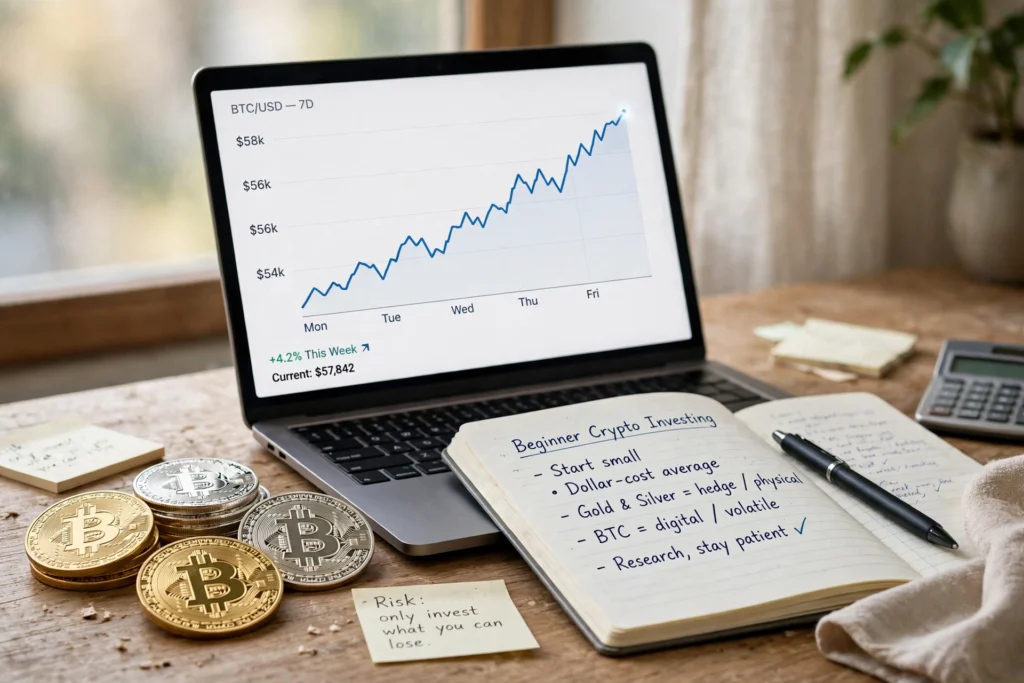
If you decide to start, the most widely repeated advice from experienced investors is to begin small. Put in only money you can afford to lose completely, and treat your first purchase as a learning exercise rather than a way to get rich. A common approach is dollar-cost averaging: buying a fixed, modest amount at regular intervals, for example weekly or monthly, instead of investing a large sum all at once. This spreads your purchases across different prices and removes the pressure of trying to time the market — which even professionals get wrong most of the time.
Before you buy anything, do your own research. Read the project’s own documentation and whitepaper, check who is behind it, look at whether it has a real use or just a marketing pitch, and see how it has behaved in past market downturns. A coin that is popular on social media this week is not necessarily a sound investment. Related reading on this site includes our guide to cryptocurrency trading cards, which shows how the same blockchain technology is used for digital collectibles — a reminder that the technology has uses well beyond speculation.
Understanding the Risks
Cryptocurrency prices are famously volatile. It is normal for a coin to rise or fall by a large percentage in a single day, and whole market cycles have seen prices fall by half or more and stay down for months or years. That volatility is the reason some people make large gains — and the reason others lose large amounts. No strategy removes this risk.
Beyond price swings, there are other risks beginners often overlook. Regulations vary by country and change frequently; a coin that is legal to trade in one place may be restricted in another, and tax rules on crypto gains differ widely. Scams are common, from fake exchanges and phishing emails to social-media accounts impersonating well-known figures and promising to double your money. And unlike a bank deposit, cryptocurrency holdings are generally not insured: if you lose your keys or send coins to the wrong address, the money is usually gone for good.
Common Beginner Mistakes
The most damaging beginner mistakes are usually psychological rather than technical. Panic selling during a price drop locks in a loss that might have recovered; chasing a coin because its price is rising fast often means buying at the top. Investing borrowed money, or money needed for rent and bills, turns a risky investment into a dangerous one. Putting everything into a single small coin, or into a coin recommended by an anonymous account online, is a bet, not a plan.
Two practical habits help more than any trading tip. First, write down your plan before you buy: how much you are investing, why you chose that coin, and at what point you would sell. Second, keep your security boring and consistent — strong unique passwords, two-factor authentication, and a backup of your recovery phrase stored offline, somewhere safe. Most crypto losses by beginners come from simple security lapses, not from choosing the wrong coin.
How to Evaluate a Cryptocurrency Before Buying
There is no checklist that guarantees a good investment, but a few questions separate serious projects from hype. What problem does this coin solve, and does it need a blockchain to solve it? Who built it, and are they publicly known? Is the code openly available and actively developed? How widely is it actually used, rather than merely traded? Is the supply fixed or inflationary, and who holds most of it?
Market data sites can help you check basic facts such as market value, trading volume and supply, but treat price predictions and influencer recommendations with scepticism. If a project cannot explain its purpose in plain language, that is itself useful information. Mining is another corner of the crypto world worth understanding before you judge it: our article on cryptocurrency mining and solar power explains how new coins are created and why mining uses so much energy — context that helps you understand where coins come from in the first place.
A Short Note on Tax and Regulation
In many countries, selling cryptocurrency at a profit is a taxable event, and some countries require you to report holdings or trades even when you have not sold. Rules differ widely and change often, so check the requirements where you live, keep records of every purchase and sale, and consider professional advice if your activity grows. This article is general educational information, not financial advice, and it is not a recommendation to buy any particular cryptocurrency.
Frequently Asked Questions
How much money do I need to start investing in cryptocurrency?
There is no minimum that makes sense for everyone. Most major exchanges let you buy a fraction of a coin for a small amount, so you can start with whatever you can comfortably afford to lose. The amount matters far less than understanding what you are buying and keeping your investment small relative to your overall finances.
Is cryptocurrency a safe investment?
No investment is safe, and cryptocurrency is among the riskiest. Prices can fall sharply, exchanges can fail, regulations can change, and scams are common. The risk can be reduced — by starting small, diversifying, using secure wallets and avoiding borrowed money — but it cannot be removed.
Should I buy Bitcoin or a smaller altcoin?
This article does not recommend specific coins. In general terms, the largest cryptocurrencies have longer track records and deeper markets, while smaller coins can move more dramatically in both directions and carry higher risk. Whatever you consider, research it yourself and never invest on the basis of a social-media tip alone.
What is the difference between an exchange and a wallet?
An exchange is a marketplace where you buy and sell cryptocurrency. A wallet is where you store the private keys that control your coins. Many exchanges include a built-in wallet, but moving coins to a wallet you control — especially a hardware wallet for larger amounts — reduces the risk of losing funds if the exchange is hacked or fails.
Can I lose all my money in cryptocurrency?
Yes. A coin can lose most or all of its value, an exchange can collapse, or you can lose access to your wallet. That is why the standard advice is to invest only money you can afford to lose completely, and never money you need for essential expenses.
Conclusion
Cryptocurrency investing starts with understanding, not with buying. Learn what a blockchain is, how exchanges and wallets work, and why prices move so violently before you risk any money. Start small, use dollar-cost averaging if it suits you, keep your security disciplined, and be honest with yourself about how much risk you can actually tolerate. The technology behind cryptocurrency is genuinely interesting and still developing, but the market rewards patience and research far more reliably than it rewards urgency. If you take one idea from this guide, let it be this: in crypto, the most expensive mistakes are usually made in a hurry.