Your flight is cancelled — or delayed for hours — and everyone at the gate is standing around waiting for someone else to fix it. Here is what to do, in order: find out why the flight is disrupted, rebook yourself on the fastest alternative, know exactly what the airline owes you, and document everything so you can claim money back later. The first 30 minutes after a cancellation matter more than anything else you do that day.
Step 1: Get the facts first
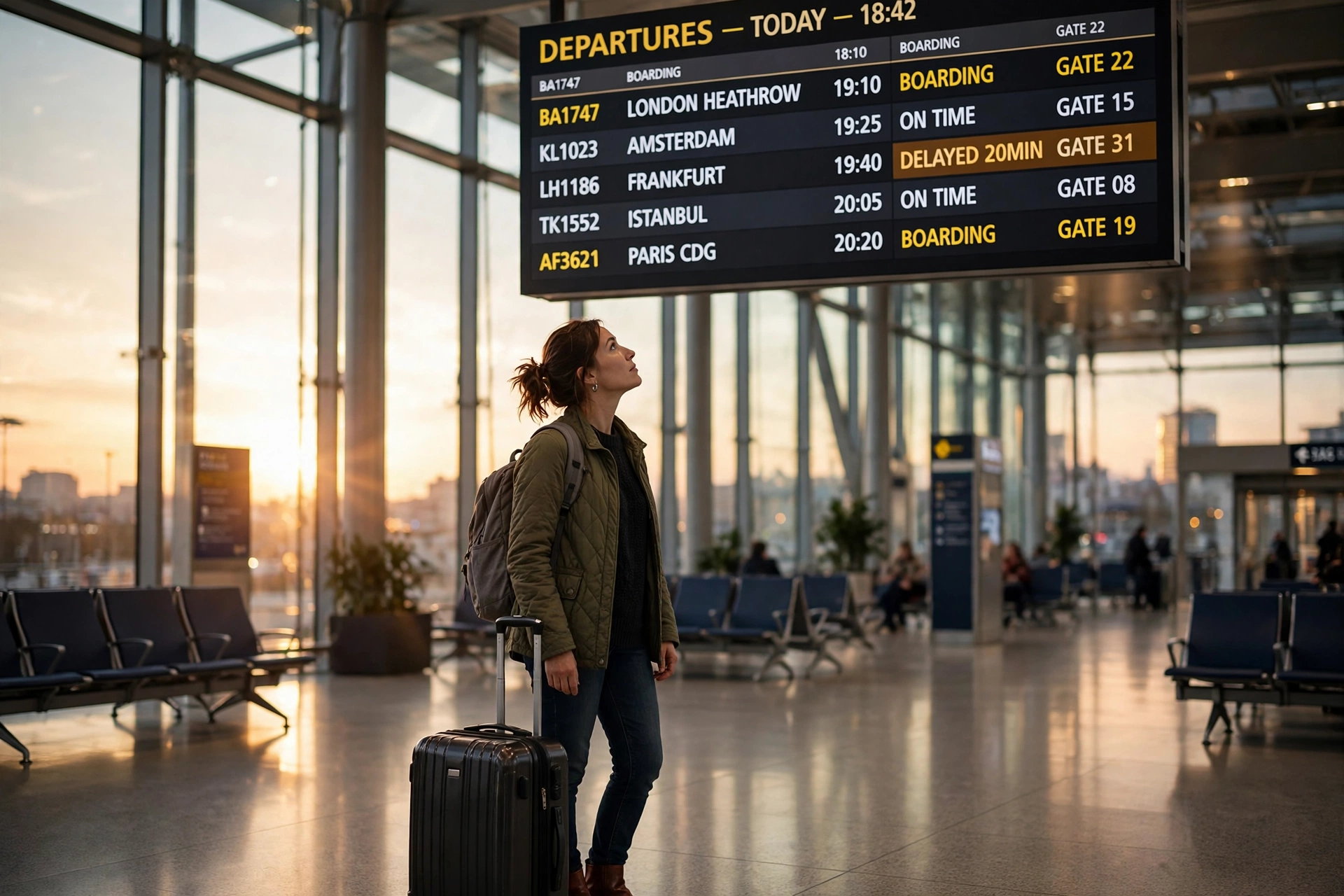
Before you queue at the service desk, find out what actually happened. Open the airline’s app — it usually shows rebooking options and the official reason for the disruption before the gate agent can explain it to 200 people. The departure board and the app should agree; if they don’t, trust the app or ask staff directly.
The reason for the disruption matters, because your compensation rights depend on it. A mechanical problem, a crew shortage, or a late incoming aircraft is the airline’s responsibility. Severe weather, air traffic control restrictions, and security incidents are generally classified as “extraordinary circumstances,” which changes what you can claim. If a staff member gives you a reason, note the exact wording and the time — you’ll need it if you file a claim later.
Step 2: Rebook before everyone else does
The moment you know the flight won’t leave, start rebooking — don’t wait in line first. Check the airline’s app for alternative flights; most major airlines now let you pick a new flight yourself in seconds. Call the airline’s reservations line at the same time; the phone queue is often shorter than the desk queue, and phone agents can see the same inventory.
A few rebooking tactics that actually work:
- Look at nearby airports. If your flight to Chicago is cancelled, a flight to Milwaukee or Indianapolis may get you there sooner than the next available Chicago flight.
- Consider other airlines. In the EU, airlines are expected to get you to your destination at the earliest opportunity, which can include rebooking on a competitor. In the US, policies vary, but it never hurts to ask — agents can sometimes endorse your ticket to another carrier.
- Watch connection risks. A “rebooking” that adds two connections and lands at 2 a.m. might be worse than waiting for the direct flight tomorrow. You can decline an alternative and ask for a different one.
If you’re stranded abroad without mobile data, a travel eSIM for instant data abroad can be the difference between rebooking in five minutes and waiting an hour at the information desk.
Step 3: Know your rights: refunds and compensation
This is where most passengers leave money on the table. Your rights depend on where you’re flying:
In the United States: Under the Department of Transportation’s refund rule (14 CFR §259.5, in effect since October 2024), airlines must provide automatic cash refunds to your original payment method when your flight is cancelled or significantly changed and you don’t accept the alternative. A delay of 3+ hours on a domestic flight or 6+ hours on an international flight counts as significant. Refunds must arrive within 7 business days for credit card purchases or 20 calendar days for other payment methods — and you no longer have to fight customer service to get cash instead of a voucher (see the rule explained here). Note that the US rule covers refunds, not fixed delay compensation — there is no American equivalent of the EU’s per-passenger payout.
In the EU and UK: Regulation EC 261/2004 (and the UK’s retained version, UK261) goes further. If your flight is cancelled with less than 14 days’ notice, or arrives 3+ hours late at your final destination, and the cause was within the airline’s control, you can claim fixed compensation:
- €250 for flights up to 1,500 km
- €400 for flights between 1,500 and 3,500 km
- €600 for flights over 3,500 km
This applies to any airline departing an EU/UK airport, and to EU/UK carriers arriving from outside. It is a flat cash amount per passenger — it doesn’t depend on the ticket price (full breakdown of who qualifies). Claim directly with the airline first; it’s free.
What the airline can’t escape: extraordinary circumstances (real weather events, ATC strikes, security threats) cancel the fixed compensation — but they do not cancel your right to a refund or rebooking, and they do not cancel the airline’s duty of care (see Step 4). The burden is on the airline to prove the cause was extraordinary, not on you.
Step 4: Make the airline cover food and a hotel
For long delays, airlines owe you care while you wait — regardless of why the flight is delayed. Under EU261, this “duty of care” kicks in after 2 hours (short flights), 3 hours (medium flights), or 4 hours (long flights): meals and refreshments, two phone calls or emails, and hotel accommodation with transport if you’re delayed overnight. This duty applies even for weather cancellations.
In the US, meals and hotels aren’t a federal legal requirement, but every major airline has voluntarily committed to specific care policies for disruptions within its control — the DOT publishes them on its Airline Cancellation and Delay Dashboard. Check your airline’s commitments, then ask staff to honor them specifically: “Your customer service plan says you provide hotel accommodation for overnight controllable delays — can you arrange that?”
If the airline can’t or won’t arrange a hotel, book a reasonable one yourself and keep the receipt. Reasonable means an ordinary airport-area hotel, not a luxury suite — claims get rejected when the spending looks extravagant.
Step 5: Document everything and keep every receipt
Your claim is only as strong as your evidence. While the disruption is happening, save:
- Screenshots of the airline app showing the cancellation/delay notice and the stated reason
- Photos of the departure board showing your flight status
- Your booking confirmation, boarding pass, and any rebooking confirmations
- The name of any staff member who gave you information, and what they said
- Every receipt — food, drinks, hotel, taxi, phone calls, even bottled water
Email the receipts to yourself so a lost phone doesn’t mean lost evidence. If you bought travel insurance that actually covers trip interruptions, check its receipts requirements too — some policies require specific documentation.
Step 6: Claim what you’re owed after you land
Once you’re home, file your claims in this order:
- EU261 compensation (if applicable): file directly with the airline through its claims page — free, and you keep 100% of the payout. You don’t need a paid claim service. Deadlines vary by country, but in many EU countries you have several years, so don’t assume an old disruption is too late to claim.
- Expense reimbursement: submit your receipts to the airline for meals, hotels, and transport. Be polite and factual; include booking references and a clear itemized list.
- US DOT complaint (if the airline refuses a refund or ignores you): filing a complaint with the Department of Transportation is free and often gets results when the airline has gone quiet.
- Travel insurance: for costs the airline won’t cover — non-refundable hotel deposits, tours you missed, extra travel days. File with the documentation from Step 5.
On international itineraries, the Montreal Convention may also let you recover consequential losses (like missed prepaid accommodation), but that’s a separate legal route and worth looking into only for larger amounts.
FAQ: Flight cancellations and delays
Can I get cash instead of a voucher? In the US, yes — the 2024 DOT rule requires airlines to provide automatic cash refunds to your original payment method for cancelled or significantly changed flights when you decline the alternative. You should never have to accept a voucher. In the EU, you have an unconditional right to choose a full refund instead of rerouting when your flight is cancelled.
My flight was cancelled because of weather. Do I get anything? Weather is an extraordinary circumstance, so no EU fixed compensation. But you still get a full refund or free rebooking, plus duty of care (meals, refreshments, and a hotel if you’re stuck overnight in the EU). In the US, the refund right applies regardless of the cause.
I missed my connection because the flights were on separate tickets. What now? This is the risky scenario. Airlines generally aren’t responsible for missed connections on separate bookings — the second airline treats you as a no-show. Your options: travel insurance with missed-connection coverage, or the Montreal Convention route on international itineraries. This is why booking connections on a single ticket is worth the small premium.
How long do I have to file an EU261 claim? It depends on the country where you file — limitation periods vary, and in many EU countries you have several years. Keep your boarding pass and booking confirmation indefinitely; a claim you think is old may still be valid.
The bottom line
A cancelled flight is a logistics problem, not a dead end. Get the facts, rebook yourself before the crowd, know the refund and compensation rules that apply to your route, and document everything. Most passengers who claim properly recover real money — the ones who don’t are the ones who waited at the gate and went home with nothing but a story.