
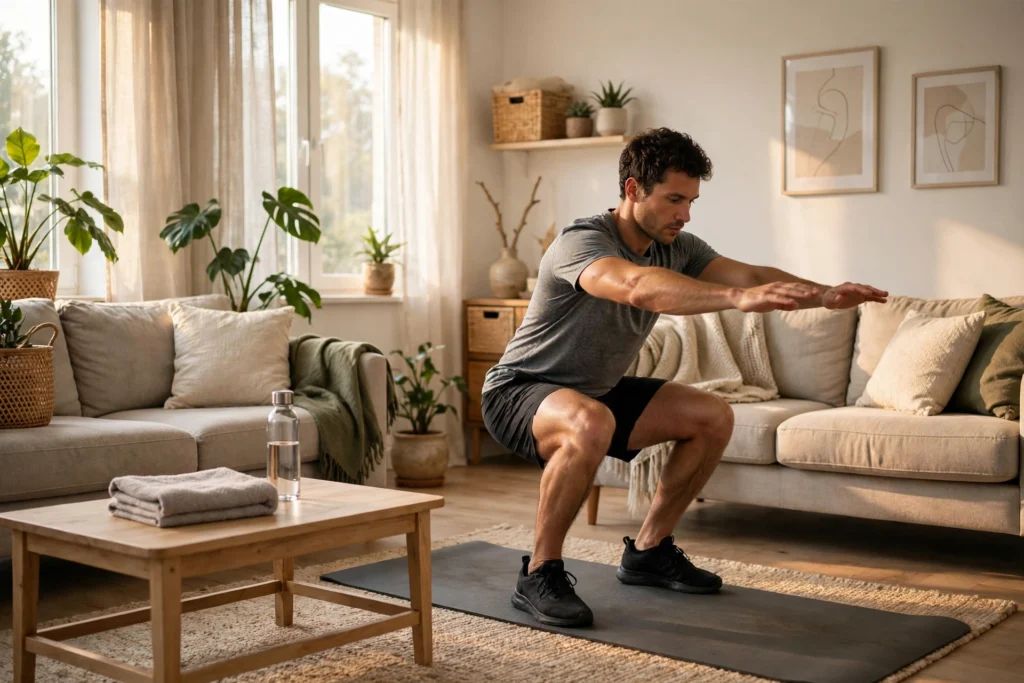
You don’t need a gym, dumbbells, or an hour to spare to get a real workout. This 30-minute no-equipment home workout uses only your bodyweight, follows a simple structure — 5-minute warm-up, 20-minute circuit, 5-minute cool-down — and is designed for genuine beginners. Every exercise includes form cues and an easier modification, so you can start today no matter your fitness level. Pair this routine with good health habits on the road and you have fitness covered at home and away.
Before You Start: Safety Rules
- Clear a space about the size of a yoga mat; a carpet or mat protects your knees and back.
- Wear supportive shoes or go barefoot on a non-slip surface — whichever feels stable.
- Keep water nearby and breathe continuously: exhale on the effort, inhale on the return.
- Stop if you feel sharp pain, dizziness, or chest discomfort. Muscle burn is fine; joint pain is not.
- If you have a medical condition, are pregnant, or are returning from injury, check with your doctor first.
Minutes 0–5: Warm-Up
Do each move for 45 seconds, moving gently — the goal is warm muscles, not exhaustion:
- March in place — lift knees to hip height, swing arms naturally.
- Arm circles — 20 seconds forward, 20 seconds backward, gradually widening.
- Hip circles — hands on hips, big slow circles each direction.
- Leg swings — hold a wall, swing each leg forward and back 10 times.
- Bodyweight squats (easy) — slow, shallow squats to wake up the legs.
Minutes 5–25: The Full-Body Circuit
Perform each exercise for 40 seconds of work followed by 20 seconds of rest, then move to the next. That is one round (about 7 minutes). Complete 3 rounds, resting 1 minute between rounds. Focus on form over speed — sloppy fast reps teach your body bad habits.
1. Bodyweight Squats
Feet shoulder-width apart, toes slightly out. Push your hips back like sitting into a chair, keep your chest up and knees tracking over your toes. Modification: squat to a chair — tap it lightly and stand back up.
2. Incline Push-Ups
Hands on a sturdy table, couch edge, or wall; body in a straight line from head to heels. Lower your chest toward the surface, elbows at about 45 degrees. Modification: use a wall instead of a table — the more vertical you are, the easier it gets.
3. Glute Bridges
Lie on your back, knees bent, feet flat and hip-width apart. Squeeze your glutes and lift your hips until your body forms a straight line from shoulders to knees. Pause one second at the top. Modification: reduce the range — lift halfway.
4. Standing Knee-to-Elbow
Stand tall, hands behind your head. Lift your right knee and bring your left elbow toward it, engaging your core; alternate sides. Keep it controlled, not jerky. Modification: do it seated in a sturdy chair.
5. Reverse Lunges
Stand tall, step one foot straight back, and lower until both knees are near 90 degrees. Push through the front heel to return. Alternate legs. Modification: do stationary split squats holding a wall for balance.
6. Dead Bug
Lie on your back, arms reaching toward the ceiling, knees bent at 90 degrees over your hips. Slowly lower your right arm overhead while extending your left leg, keeping your lower back pressed into the floor. Return and alternate. Modification: keep the working leg bent instead of straightening it.
7. Plank Hold
Forearms on the floor, body straight from head to heels, core braced like someone is about to poke your stomach. Don’t let hips sag or pike up. Modification: drop to your knees — same straight line from knees to head.
Minutes 25–30: Cool-Down
Hold each stretch for 30–45 seconds, breathing slowly:
- Standing quad stretch — hold a wall, pull one foot toward your glute; switch sides.
- Hamstring fold — hinge at the hips, reach toward your toes, soft knees.
- Chest opener — clasp hands behind your back, lift gently, open the chest.
- Child’s pose — knees wide, arms extended, forehead down; breathe into your back.
- Neck rolls — slow half-circles, ear toward shoulder, each direction.
Beginner Modifications: Make It Yours
If the full circuit feels like too much in week one, that is normal — fitness is built, not downloaded. Three dials you can turn:
- Shorten the work intervals: do 30 seconds of work / 30 seconds of rest instead of 40/20.
- Do 2 rounds instead of 3: a 20-minute workout you actually finish beats a 30-minute one you quit.
- Use every modification listed: there is zero shame in incline push-ups and chair squats. They build the exact same muscles.
Progress when the current version feels easy: add the third round first, then lengthen work intervals, then drop the modifications one exercise at a time.
Your Weekly Schedule
- Monday: full 30-minute routine
- Tuesday: rest or a 20-minute walk
- Wednesday: full 30-minute routine
- Thursday: rest or gentle stretching
- Friday: full 30-minute routine
- Weekend: one active day (walk, bike, play) and one full rest day
What Results to Expect
Be realistic about the timeline. In weeks 1–2, expect muscle soreness (especially in the legs and glutes) and workouts that feel harder than they look — that’s your body adapting, and it’s a good sign. By weeks 3–4, the same circuit will feel noticeably easier: your balance improves, your form cleans up, and you recover faster between rounds. That’s your cue to progress using the dials above. By week 8, most beginners report better energy through the day, easier stairs, and less back stiffness from sitting. Visible muscle definition takes longer — typically 8–12 weeks of consistency plus reasonable nutrition — but the strength and stamina gains arrive much sooner and they’re what matter most.
Three sessions a week is the sweet spot for beginners — enough stimulus to get stronger, enough recovery to stay consistent. And consistency is the whole game: light movement on tired travel days also helps, which is why gentle exercise is part of any good jet lag recovery plan too. Start with Monday. Your future self will thank you.