
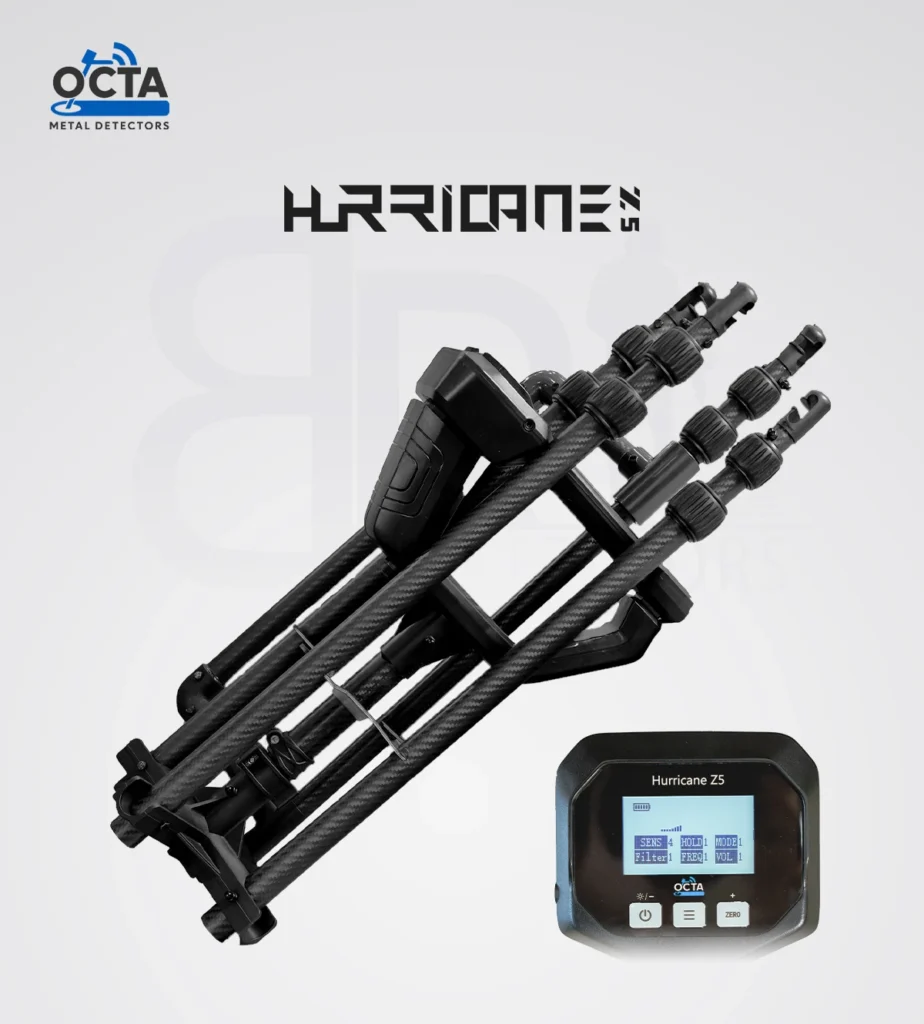
The Hurricane Z5 is a gold and metal detector marketed toward prospectors who want deeper detection in tough, mineralized ground. But product pages tell you what a detector claims to do — not whether it’s the right machine for you. This guide fixes that: how gold detectors actually work, which specs matter, who the Hurricane Z5 suits, how to test any detector before paying, and the legal basics every buyer should know.
How gold detectors actually work: VLF vs pulse induction
Every serious gold detector falls into one of two technologies, and understanding the difference matters more than any brand name.
VLF (Very Low Frequency) machines transmit a continuous sine wave — typically between 3 and 80+ kHz — and measure how targets disturb it. Higher frequencies are more sensitive to tiny gold (small nuggets, fine flakes); lower frequencies penetrate deeper for larger targets. VLF detectors offer good discrimination (telling gold from bottle caps), but they struggle in mineralized soil, where iron-rich ground masks weak signals.
Pulse Induction (PI) machines fire powerful magnetic pulses and measure how long the ground’s response takes to decay. PI ignores mineralization far better than VLF and punches deeper — which is why serious prospectors in places like Western Australia, Sudan, and the deserts of the American Southwest swear by it. The trade-off: PI is generally worse at discrimination (you dig more trash), heavier on battery use, and more expensive.
Rule of thumb: hunting small gold in mild ground? VLF. Chasing deeper targets in hot, mineralized ground? PI. The Hurricane Z5 is positioned in the PI camp — marketed for depth and stability in difficult soil — which tells you immediately who it’s for and who it isn’t.
The specs that actually matter (more than brand hype)
When comparing the Hurricane Z5 — or any gold detector — judge these, in order:
- Ground balance. The single most important feature for gold country. Manual or automatic ground balancing lets the machine cancel out mineralized soil; without it, you’ll chase phantom signals all day. Ask specifically what type the Z5 offers and whether it handles highly mineralized ground.
- Coil size and type. Small coils find tiny gold near the surface; large Double-D (DD) coils go deeper and handle mineralization better. Check what coil ships in the box and whether larger/deeper coils are available — coil options determine how the machine grows with you.
- Technology class and operating specs. Confirm the detection technology (VLF frequency or PI pulse specs), sensitivity adjustment range, and threshold controls. Vague “advanced detection system” language on a product page is a red flag — real machines publish real numbers.
- Weight and ergonomics. You’ll swing this for 6–8 hours. A machine over ~1.5 kg with poor balance becomes a torture device by hour four. Check the assembled weight and shaft adjustability.
- Battery life. PI machines are power-hungry. Anything under 8 hours of real field use means carrying spares — factor that into the true cost.
- Warranty and local support. Detectors break in the field: cables, coils, shafts. A machine with no reachable service center and no spare parts pipeline is a disposable purchase at any price.
The Hurricane Z5 in context
The Hurricane Z5 is sold primarily through specialist detector dealers (notably in the Gulf region) and is marketed as a deep-seeking gold detector for mineralized terrain — the classic PI value proposition. In the market, that puts it up against established mid-range machines from brands like Minelab, Garrett, and Nokta.
Here’s the honest framing: the established brands publish detailed specifications, maintain global dealer networks, and have thousands of independent field reviews. A lesser-known machine like the Z5 may offer competitive performance at a lower price — but the burden of proof is higher. Before buying, demand the full spec sheet, search for independent field-test videos rather than dealer marketing, and confirm warranty terms in writing. If a seller can’t provide concrete specifications, treat that as your answer.
One caution that applies across this segment: be skeptical of “long-range locator” style claims — devices that promise to detect gold from kilometers away via antennas rather than search coils. Conventional coil-based detection (VLF or PI) is the proven technology; anything else deserves extraordinary evidence.
Who the Hurricane Z5 suits — and who should skip it
Consider it if: you’re an intermediate to experienced prospector hunting in mineralized ground, you understand PI’s dig-everything trade-off, you’ve verified the specs and warranty, and the price meaningfully undercuts established PI machines with equivalent support.
Skip it if: you’re a beginner (start with a mid-range VLF — cheaper, lighter, better discrimination), you hunt parks and beaches for coins and jewelry rather than goldfields, or the seller can’t produce a real spec sheet and service commitment.
How to test a gold detector before you buy
Never buy a detector you haven’t put through these checks — ideally in person, or via a dealer with a real return policy:
- Air test: wave a small gold ring or, better, a tiny gold nugget/sample past the coil at increasing distances. Note the maximum detection distance. Compare machines side by side if possible — it’s the fastest honest comparison there is.
- Buried test: bury test targets (gold ring, small coin, nail) at measured depths in your local soil. This reveals real-world depth and, critically, how the machine behaves in your ground.
- Ground balance check: pump the coil over mineralized soil and watch whether the machine balances smoothly or chatters. This is the make-or-break test for gold country.
- EMI stability: turn it on near power lines or with your phone nearby. Excessive falsing means misery in urban-fringe detecting.
- Build inspection: check shaft locks, coil ears, cable connectors, and waterproof seals. Field failures almost always start at these joints.
- Paperwork: confirm warranty length, what’s covered, where service happens, and the return window — in writing, before money changes hands.
Safety and legal notes
Metal detecting is regulated in most countries, and ignorance isn’t a defense:
- Get permission. Detecting on private land without the landowner’s consent is trespassing in most jurisdictions. Always ask first.
- Protected sites are off-limits. Archaeological sites, national parks, monuments, and heritage areas typically ban detecting outright — violations can carry serious penalties.
- Know your country’s rules. Some countries require permits or licenses for prospecting; others restrict detector imports or use. In Pakistan, for example, prospecting on state or protected land without authorization can create legal trouble — check current regulations and stick to land where you have clear permission.
- Dig responsibly. Cut clean plugs, refill every hole, and carry out all trash — including the junk targets you dig. Detectorists lose access to land because of the few who leave it looking like a battlefield.
- Field safety: carry water, tell someone your plans in remote areas, watch for wildlife and unstable ground, and never detect alone in isolated terrain.
Where detectorists actually go
If you’re serious enough to buy a machine like the Z5, you’ll eventually plan trips around detecting. The desert Southwest of the United States is classic prospecting country — our guide to Utah’s top places covers terrain where detectorists roam, and summer in Montana pairs mountain trails with gold-rush history. Always verify local detecting rules before you swing a coil on any trip.
Verdict
The Hurricane Z5 targets a real need — deeper gold detection in mineralized ground at a price below the big-brand PI flagships. Whether it delivers depends on specifications and support that only a thorough pre-purchase check can confirm. Use this guide’s checklist: verify the technology class and ground balance, test in real soil, confirm warranty and service, and buy from a dealer with a return policy. Do that, and whatever machine you choose — Z5 or otherwise — you’ll own it with confidence instead of hope.